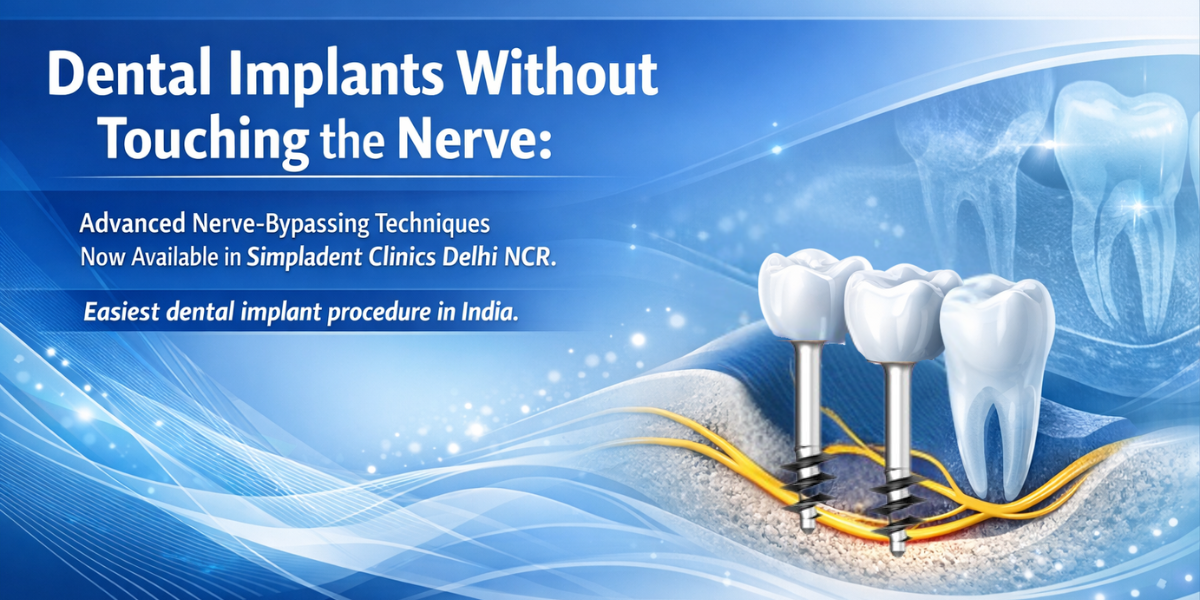
Modern implantology has evolved to address one of the most feared complications in lower-jaw implant placement – injury to the inferior alveolar nerve. At Simpladent Clinics in Delhi NCR, advanced nerve-bypassing techniques now allow safe Dental Implants rehabilitation even in anatomically complex cases, without vertical bone grafting or nerve transposition.
Possibilities of Dental Implants Installation “bypassing” Inferior Alveolar Nerve: Results of CBCT analysis as published by IF Publishing, Munich, Germany.
A patient born in 1972 was suffering from consistent tooth pain in the left posterior mandible, and the bridge covering teeth 44 to 47 was becoming loose. Based on examination, endodontic and prosthetic failure were expected, leading to a complete radiological assessment.
A cone-beam computed tomography scan was performed to assess bone, neural anatomy, and inflammatory spread. CBCT imaging revealed active periapical inflammation associated with teeth 44, 47, and 48, along with the close proximity of the mandibular canal – making conventional implant placement risky.
Please contact us @ +91 9289678861 for more info
CBCT-Based Planning and Nerve-Bypassing Strategy
Using three-dimensional CBCT analysis, precise measurements of the distal mandibular aspects were obtained. The mandibular canal trajectory, mental nerve loop, and lingual cortical plate were digitally mapped. Based on these findings, a treatment plan was proposed involving strategic implant placement along the lingual cortical pathway, deliberately bypassing the nerve canal.
After informed consent, extraction of teeth 44, 47, and 48 was carried out under local anesthesia with premedication. Thorough mechanical and medical curettage of the inflamed regions followed.
Surgical Execution and Implant Placement
Three single-piece, cone-shaped implants (KOS® and KOS® Micro, Ihde Dental AG, Switzerland) were installed in the positions of teeth 44, 45, and 46 using lingual angulation. Hence, durable anchorage in cortical bone was achieved and the inferior alveolar nerve was bypassed completely.
The implant in region 44 was angled toward the front to fit around the mental nerve loop. Its abutment head was later adjusted by carefully bending the implant neck by hand, which is a key part of advanced implantation protocols. A follow-up CBCT scan two days after surgery confirmed the implants were in the right place, with no damage to the mandibular canal or lingual cortex.
Three days after surgery, a temporary metal-acrylic bridge was placed under full bite pressure, following immediate functional protocols. This avoided long healing delays.
Conclusion
Simpladent Clinics, led by Dr. Vivek Gaur, implements the advanced nerve-bypassing techniques wherein meticulous planning, advanced imaging, and deep anatomical expertise are included.
Keep yourself updated by following our Social Page for the latest news and information.