If you have been missing multiple teeth for several years, the chances are that your jawbone has shrunk considerably. The crestal bone — the layer that once held your tooth roots — starts to resorb within months of a tooth being lost and continues doing so over time. By the time many patients reach an implant consultation, they are told the same thing: not enough bone for conventional implants, and bone grafting is the necessary first step.
That is the conventional route, and it is a long one — often extending total treatment by a year or more. But for a growing number of patients, it is not the only route. Corticobasal® and basal implant techniques were specifically developed to treat patients with significant bone loss, using the bone that remains rather than waiting to rebuild what has been lost.
Why Standard Full Mouth Implant Cases Often Require Grafting
Please contact us @ +91 9289678861 for more info
Conventional dental implants are designed for vertical placement into the crestal bone — the upper, softer layer of the jaw. They need a minimum volume of this bone for stable anchorage. Full mouth cases (replacing all teeth in one or both jaws) amplify this requirement: multiple implants across the entire arch, all needing adequate bone at their individual sites.
When the crestal bone has resorbed significantly — as is common in patients who have worn complete dentures for many years — conventional placement becomes untenable without augmentation. Bone graft material is added, healing is awaited, and then implant placement proceeds. It works in the right cases, but it is a two-stage surgical journey with a meaningful waiting period between them.
How Basal and Corticobasal® Implants Change the Equation
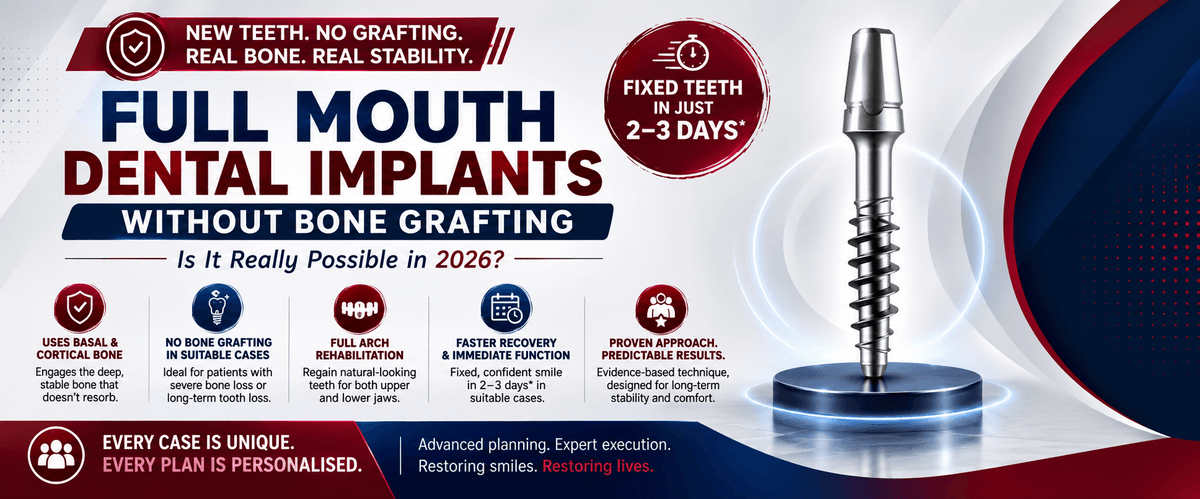
Basal and Corticobasal® implants anchor in the cortical and basal bone — the denser, deeper layers that persist even when the surface crestal bone has collapsed. Because these implants reach past the resorbed layer and engage structurally stable bone, they can achieve the primary stability needed for full mouth treatment without requiring a reconstruction of the surface bone first.
The treatment plan for a full mouth basal or Corticobasal® case is designed from the CBCT scan outward: the surgeon maps where usable cortical bone exists, plans implant positions and trajectories to engage it precisely, and designs the prosthetic bridge to distribute functional load efficiently across all implants. The result, in suitable cases, is a full arch of fixed teeth without the grafting phase.
Corticobasal® implants are by far the easiest and fastest way for a patient to get missing teeth restored in less than 2-3 days !
What the Process Actually Looks Like
For patients in Delhi NCR considering this path, the process begins with a comprehensive consultation and 3D imaging. The CBCT scan is analysed to confirm whether sufficient cortical bone exists at the planned implant sites. If it does, a digital treatment plan is created, and the patient is given a realistic picture of what the surgical phase will involve, how many implants will be placed, and what the provisional and final prosthesis will look like.
Surgery is typically completed in a single extended session. In cases where immediate loading is confirmed — based on primary stability achieved during surgery — provisional fixed teeth are attached within 24 to 72 hours. Patients in suitable cases leave the clinic with a fixed bridge. The final prosthesis follows after a stabilisation period.
Frequently Asked Questions
Q: How many implants are placed for a full mouth case?
This varies by case, jaw anatomy, and available bone. Full mouth basal or Corticobasal® cases may involve six to ten or more implants per jaw, positioned to engage available cortical bone. Your surgeon will determine the number and position from the 3D scan.
Q: Can both upper and lower jaws be treated simultaneously?
In suitable cases, both jaws can be treated in one surgical session. This depends on the patient’s overall health and the complexity of the case. Your surgeon will advise on the most appropriate staging for your situation.
Q: What is the difference between basal implants and Corticobasal® implants?
Both types engage the denser basal bone rather than the crestal layer. Corticobasal® is a specific implant design that engages the cortical plate through its thread structure. The selection of implant type is based on the patient’s bone anatomy and is decided by the treating surgeon after evaluation.
Q: If I’ve been wearing dentures for 15 years, am I eligible for this treatment?
Long-term denture wear causes significant bone resorption, which is precisely the patient profile this approach addresses in suitable cases. Eligibility depends on how much cortical and basal bone remains, confirmed by 3D imaging. A consultation is the right starting point.
Q: How long does the treatment take from consultation to final teeth?
In suitable immediate loading cases, provisional fixed teeth can be placed within a few days of surgery. The final prosthesis is typically completed several months later. Total treatment time varies by case and is discussed clearly during the planning phase.
If you have been told bone grafting is your only path to dental implants, plan your consultation with Dr. Vivek Gaur at Simpladent, Kaushambi, Ghaziabad. A personalised 3D evaluation will clarify what is clinically possible for your case.
Disclaimer: This article is for general health awareness only. A formal diagnostic evaluation by a registered dental surgeon is required before any treatment decision is made.