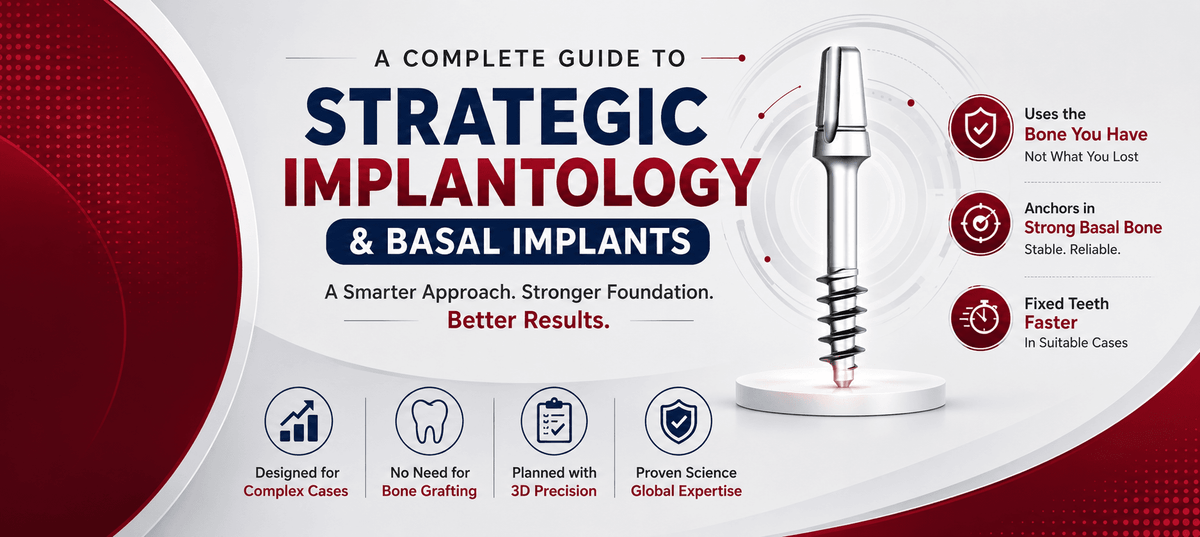
The term “strategic implantology” is heard increasingly in conversations about advanced dental care, but it is not yet well understood by most patients — or, for that matter, by many general dental practitioners. This guide explains the concept clearly: what it means clinically, what bone structures it targets, how it differs from conventional implant approaches, and why it matters for patients who have been told their bone is insufficient for standard treatment.
The Core Principle: Use the Bone That Exists
Strategic implantology starts from a different premise than conventional implant dentistry. Conventional treatment asks: “Does the patient have enough crestal bone for standard implants? If not, how do we build more?” Strategic implantology asks a different question: “What bone exists right now, and how can we design a treatment plan around it?”
Please contact us @ +91 9289678861 for more info
The answer to that second question leads to the cortical and basal bone — the dense, structurally stable layers deeper in the jaw that resist the resorption affecting the crestal surface. These layers persist even in patients who have experienced significant surface bone loss over years of tooth absence or gum disease.
Understanding Basal Bone: Why It Doesn’t Resorb
The crestal bone — the layer immediately beneath the gum line — exists functionally to support teeth. Without that stimulation, it shrinks. This is why patients who have been missing teeth for years have visibly less jaw height than they once did: the crestal bone has resorbed progressively.
The basal bone is different. It is the bone that forms the structural base of the jaw, providing the framework from which the crestal layer projects. Because it serves a structural rather than purely dental function, it does not undergo the same use-dependent resorption. This makes it a stable, reliable target for implant anchorage in patients where the crestal bone is no longer viable.
Basal Implants: Designed for This Anatomy
Basal implants — including the Corticobasal® design — are specifically engineered to reach and engage this deeper bone layer. The thread geometry, implant dimensions, and placement trajectory all differ from conventional crestal implants, reflecting the different mechanical environment of basal bone.
In strategic implantology, the implant plan is not designed from a standard protocol applied to each patient. It is designed from the CBCT scan outward — mapping the specific volume, density, and geometry of available basal bone, then placing each implant at the precise position and angle that achieves stable anchorage within that patient’s unique anatomy.
How This Changes Treatment for Complex Cases
For patients who have been excluded from conventional implant treatment due to bone loss, strategic implantology changes the clinical equation fundamentally. It reframes the treatment challenge from “insufficient bone” to “bone in different locations than conventional protocols require” — and builds the implant plan to address that reality.
This means full mouth rehabilitation without bone grafting is achievable in many suitable patients; immediate loading of fixed prosthetic teeth can be considered in appropriate cases; and patients who have had previous conventional implant failures can be re-evaluated from a completely different anatomical starting point.
Training: Why Not Every Implantologist Practices Strategic Implantology
Strategic implantology and basal implant placement require training that goes well beyond conventional implant curricula. The planning is more complex, the surgical trajectories are different, and the prosthetic design must integrate precisely with a multi-implant system placed at varying angles. This training is available at specific international centres, which is where the technique was developed and refined.
Dr. Vivek Gaur’s training in strategic implantology — including programmes in Munich and the Netherlands — gives his practice in Kaushambi, Ghaziabad the specific expertise to evaluate and treat patients who have been turned away by clinics operating within conventional implant parameters only.
Frequently Asked Questions
Q: Is strategic implantology the same as basal implants?
Strategic implantology is the broader clinical philosophy — treating patients using the stable bone that exists rather than rebuilding what has been lost. Basal and Corticobasal® implants are the specific implant types most commonly used within this approach.
Q: Who developed strategic implantology?
Strategic implantology and the associated basal implant techniques were developed and refined by researchers and clinicians primarily in Europe — particularly in Switzerland, Germany, and the Netherlands. The approach gained wider application over the past two decades as the evidence base grew.
Q: Is strategic implantology available across India?
Very few clinics in India have trained specialists in strategic implantology. Dr. Vivek Gaur’s clinic in Kaushambi, Ghaziabad is a focused implant centre offering this approach to patients from across Delhi NCR and beyond.
Q: Does strategic implantology always avoid bone grafting?
In many suitable cases, yes — because the implant plan uses basal bone that has not resorbed. However, some patients may require grafting even within this framework, depending on the specific anatomy. A CBCT-based evaluation determines what is feasible.
Consult Dr. Vivek Gaur at Simpladent, Kaushambi, Ghaziabad to find out whether strategic implantology and basal implants are applicable to your case.
Disclaimer: This article is for general health awareness only. A formal diagnostic evaluation by a registered dental surgeon is required before any treatment decision is made.