Patients who need dental implants in the upper back jaw — where the molars and premolars sit — often receive a sinus lift recommendation before treatment can proceed. It is presented as unavoidable. In many cases, it genuinely is the right clinical choice. But in many others, it is a consequence of evaluating the case through the lens of conventional implant techniques only. When a different implant approach is applied, sinus lift surgery is not always necessary.
Why the Sinus Is a Problem for Upper Jaw Implants
The maxillary sinuses are air-filled cavities in the cheekbones that extend downward, sitting close to — and after tooth loss, often expanding into — the space above the upper back jaw ridge. After teeth in this region are lost, two things happen simultaneously: the crestal bone at the ridge shrinks upward, and the sinus expands downward (pneumatisation). The result is a narrow corridor of bone between the ridge and the sinus floor — sometimes as little as three to four millimetres.
Please contact us @ +91 9289678861 for more info
Conventional implants need a minimum vertical bone height to sit entirely within bone without perforating the sinus. When that height is insufficient, a sinus lift (sinus augmentation) is performed: a surgeon accesses the sinus from the cheek side or the ridge, lifts the sinus membrane, packs the space beneath it with bone graft material, and waits several months for integration before implant placement can proceed.
The Real Burden of Sinus Lift Surgery
A sinus lift is a genuine surgical procedure with a genuine recovery burden. The Schneiderian membrane — the delicate lining of the sinus — is lifted during the procedure. Membrane perforation is a documented intraoperative complication. Post-operative sinusitis, graft infection, and prolonged swelling are also possible.
Beyond the surgical risks, the timeline extension is significant. Patients typically wait six to nine months after the sinus lift for the grafted bone to integrate, followed by a further healing period after implant placement. For a patient who simply wants fixed teeth in the upper jaw, this can extend total treatment to eighteen months or more. For older patients or those with systemic health conditions, this is often impractical.
How Corticobasal® Implants Navigate the Upper Jaw Without Sinus Elevation
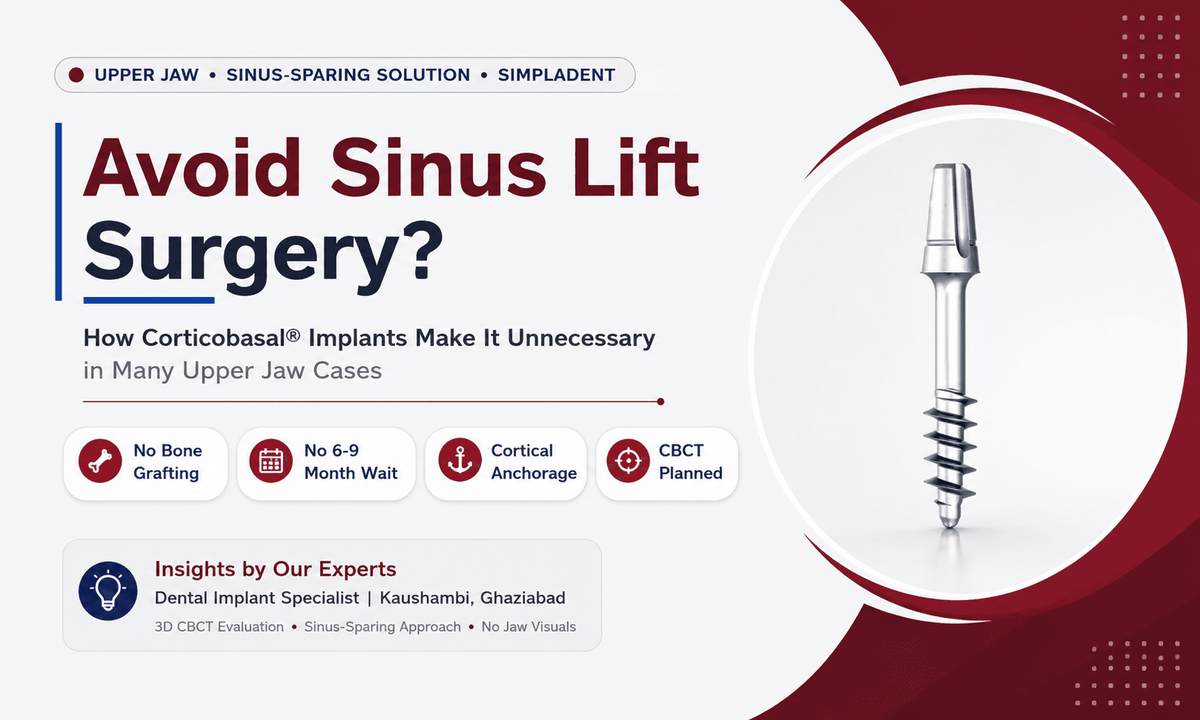
The key is trajectory. Conventional implants are placed vertically, requiring bone height beneath the sinus. Corticobasal® implants are placed at an oblique or lateral angle, engaging the cortical bone of the jaw walls and the basal bone structures — not the vertical bone height below the sinus.
By taking a lateral path that locks into cortical bone while respecting the sinus boundary — a path mapped precisely from the 3D CBCT scan — the surgeon can achieve stable anchorage without needing to elevate the sinus membrane or add bone beneath it. In many upper jaw cases with low sinus floors, this approach eliminates the sinus lift requirement entirely.
Which Patients May Avoid the Sinus Lift
Suitability for sinus lift avoidance using Corticobasal® placement depends on the specific anatomy revealed by a CBCT scan: the lateral dimensions of the jaw walls, the available cortical bone trajectory, the sinus position relative to planned implant sites, and the prosthetic requirements. Not every upper jaw case qualifies — some anatomical configurations do not present viable lateral cortical paths.
Patients who have been advised to have a sinus lift as a precondition for upper jaw implants may wish to seek an evaluation specifically from a Corticobasal® specialist, with a 3D scan, to determine whether the anatomy supports an alternative approach. This is a reasonable second opinion to seek before committing to the augmentation procedure.
Frequently Asked Questions
Q: Is a sinus lift always necessary for upper back teeth implants?
Absolutely not. It depends on the amount of vertical bone remaining below the sinus floor and whether the jaw anatomy supports an alternative implant trajectory. A CBCT scan and evaluation by a Corticobasal® specialist can clarify whether sinus augmentation is truly necessary for your case.
Q: What are the risks of a sinus lift procedure?
The main risks include Schneiderian membrane perforation during surgery, post-operative sinusitis, graft infection, and graft failure. These risks vary by surgeon experience and case complexity, but they are real considerations that patients should weigh against the option of sinus-sparing implant approaches where applicable.
Q: Does avoiding sinus lift with Corticobasal® implants compromise the outcome?
In suitable cases where cortical bone of adequate quality and volume is accessible via an alternative trajectory, Corticobasal® implant placement can achieve stable anchorage without sinus elevation. The outcome depends on the precision of planning and surgical execution, not on whether sinus augmentation was performed.
Q: How do I know if I am a candidate for sinus-sparing implant treatment?
A CBCT scan and consultation with a specialist in Corticobasal® implantology is the only reliable way to determine this. The scan provides the 3D anatomy data needed to assess whether lateral cortical anchorage is feasible at the planned implant sites.
If you have been advised to have a sinus lift before upper jaw implants, arrange a clinical evaluation with Dr. Vivek Gaur at Simpladent, Kaushambi, Ghaziabad. A 3D assessment will determine whether a sinus-sparing approach applies to your anatomy.
Disclaimer: This article is for general health awareness only. A formal diagnostic evaluation by a registered dental surgeon is required before any treatment decision is made.