Severe jaw bone loss is one of the most common reasons patients are turned away from dental implant treatment or redirected toward complex, multi-stage grafting procedures. It is also one of the areas where the difference between a general implant dentist and a specialist in strategic implantology matters most.
For many patients with significant bone loss, the choice is not between grafting and doing nothing. There is a third clinical path — one that uses the bone that is still present rather than waiting to rebuild what has been lost.
What Causes Severe Jawbone Loss
Bone loss in the jaw is almost always the cumulative result of several factors working over time. Tooth loss removes the mechanical stimulation that keeps crestal bone healthy. Chronic periodontal disease destroys bone actively around teeth before they fall. Long-term denture wear compresses and accelerates the collapse of the ridge beneath it. Systemic conditions and certain medications can compound all of this.
The result, for patients who have lived without teeth for a decade or more, is often a jaw ridge that has flattened significantly. The bone that once extended upward to support teeth roots now sits low, and there is simply not enough of it at the surface level for conventional implants.
Why Bone Grafting Is Not Always the Necessary First Step
Bone grafting can work, and in specific cases it remains the clinically appropriate choice. But it is a surgical procedure with its own set of risks — graft failure, infection, prolonged healing, nerve sensitivity — and it does not always produce sufficient bone volume for implant placement. For older patients or those with systemic health conditions, the extended treatment journey it requires can be genuinely prohibitive.
The clinical question that should precede any grafting recommendation is whether the deeper bone layers — the basal and cortical bone — can support implant anchorage without first rebuilding the crestal surface. In many cases with severe surface bone loss, the answer is yes.
How Corticobasal® Implants Access the Remaining Stable Bone
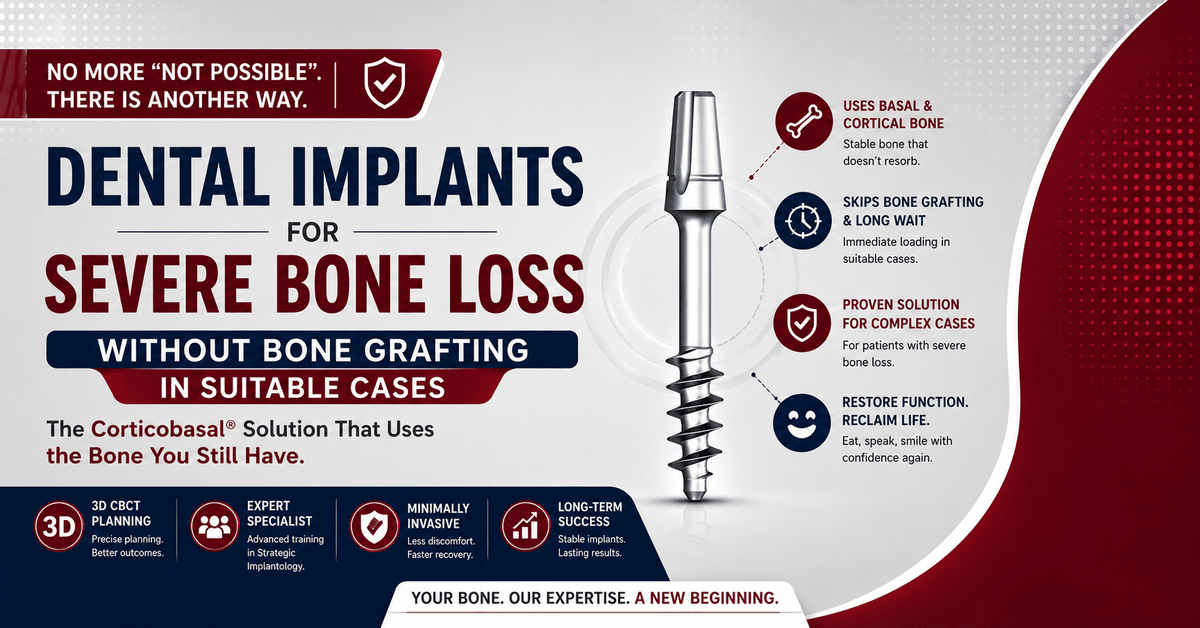
Corticobasal® implants are designed to reach the cortical and basal bone that remains intact even when the crestal layer has significantly resorbed. Using a 3D CBCT scan, the surgeon maps exactly where this dense bone exists, its volume and quality, and the precise trajectories that will allow the implant to engage it without compromising surrounding anatomical structures.
Because these implants achieve mechanical stability in bone that has not deteriorated, they can be placed and loaded — in suitable cases — without the months of grafting preparation that crestal implants require. This is not a claim about bone regeneration or surgical innovation; it is a straightforward application of the principle that stable bone, wherever it is found, can serve as an implant foundation.
What a Full Assessment Actually Involves
Patients who have been told their bone is insufficient need more than a visual inspection and a routine X-ray to evaluate this option fully. A CBCT scan is essential — it provides the 3D map of remaining bone that a 2D radiograph cannot. From that scan, a specialist in strategic implantology can identify whether cortical and basal bone is accessible at planned implant positions.
At Dr. Vivek Gaur’s Simpladent Clinic in Kaushambi, Ghaziabad, this evaluation forms the starting point for every severe bone loss case. The scan determines the feasibility; the clinical consultation discusses the realistic outcomes; and together they form a treatment plan that reflects the actual anatomy, not a standard protocol.
Frequently Asked Questions
Q: I was told I needed a bone graft before getting implants. Should I seek a second opinion?
If your assessment was based on a routine clinical examination and 2D X-ray alone, a second opinion with a 3D CBCT scan and a specialist in basal or Corticobasal® implantology may reveal additional options. This is your right as a patient.
Q: Can Corticobasal® implants be placed in patients who have had teeth missing for 20 or more years?
Potentially, yes — in suitable cases. Long-term tooth absence causes significant crestal resorption, but the deeper cortical and basal layers often remain accessible. A CBCT scan is needed to confirm what is available.
Q: What is the success rate of implants in patients with severe bone loss?
There is no universal success rate figure that applies across all patients with bone loss, as outcomes depend significantly on the extent of remaining bone, implant system used, surgical precision, and patient health. This is why individual evaluation is essential rather than relying on general statistics.
Q: How is a CBCT scan different from a regular dental X-ray?
A CBCT (cone beam computed tomography) scan produces a full 3D image of the jaw, showing bone volume, density, and depth in all three dimensions. A regular 2D X-ray shows height and width only, and cannot reveal the basal bone availability that Corticobasal® planning depends on.
Start with a clinical evaluation at Dr. Vivek Gaur’s Simpladent clinic in Kaushambi, Ghaziabad. A 3D CBCT scan and specialist assessment will determine whether Corticobasal® implants are a viable option for your specific case.
Disclaimer: This article is for general health awareness only. A formal diagnostic evaluation by a registered dental surgeon is required before any treatment decision is made.