About Dr. Vivek Gaur | Dental Implant Specialist, Kaushambi, Ghaziabad
Patients evaluating an implant surgeon face a challenge: most credentials are hard to assess without a dental background. You can see a degree on the wall, but can you tell whether the surgeon has the specific training to handle your case — particularly if it is a complex one involving bone loss, a full arch, or previous implant failure?
The question of where and how a surgeon was trained is a legitimate one. In dental implantology, the most advanced techniques — Corticobasal® implantology, strategic basal implant placement, full mouth immediate loading — were developed in specific international centres. Surgeons who trained there carry knowledge that is not available through standard dental curricula.
Please contact us @ +91 9289678861 for more info
Why International Training Matters in This Field
Advanced implantology research and technique development has largely been concentrated in Europe and North America. The protocols for cortical bone anchorage, immediate loading in compromised bone, and full mouth rehabilitation without grafting were pioneered in programmes based in Switzerland, Germany, the Netherlands, and the United States.
A dentist with basic implant training understands the standard placement procedure. A surgeon with dedicated international training in strategic implantology has something different: exposure to the cases, decisions, and complications that a large international training centre accumulates over years — and the specific hand skills and planning principles that only supervised hands-on experience builds.
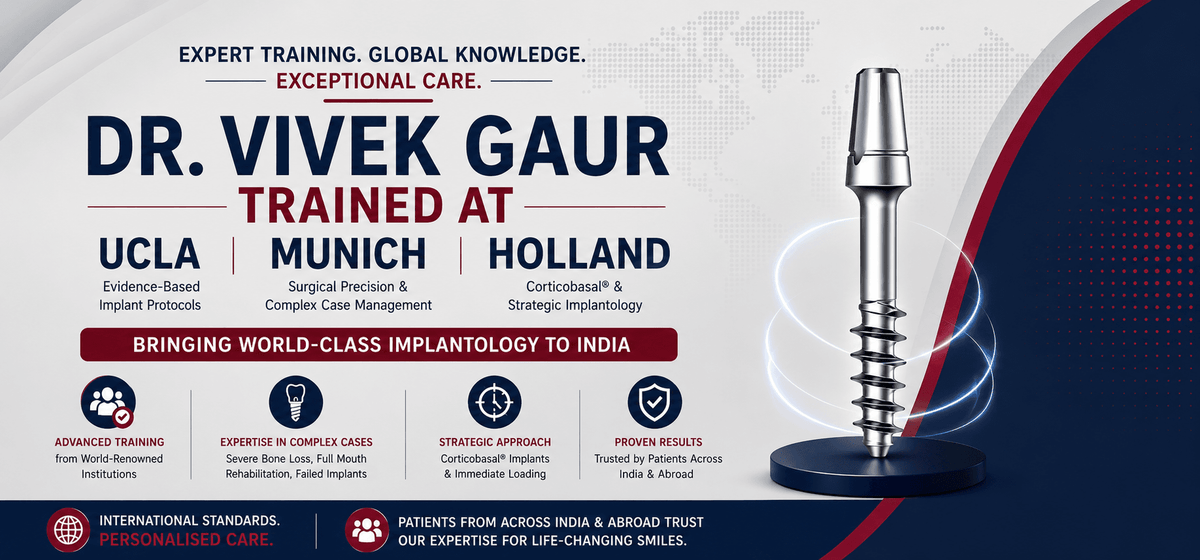
UCLA: Evidence-Based Implant and Prosthetic Protocols
UCLA’s School of Dentistry is internationally recognised for its rigorous, evidence-based approach to both implant surgery and prosthetic rehabilitation. Training in UCLA-affiliated programmes emphasises the integration of surgical planning with prosthetic outcome — the understanding that where the implant is placed must be driven by what the teeth need to look like and how the bite needs to function. This integrated thinking is foundational to complex full mouth cases.
Munich: Surgical Precision and Complex Case Management
Munich is home to some of Europe’s leading implantology training programmes, with a focus on surgical precision, complex anatomy management, and advanced full arch rehabilitation. Exposure to the volume and variety of cases managed at European centres gives surgeons calibrated clinical judgment — the ability to make nuanced intraoperative decisions that textbook training does not build.
Holland: Corticobasal® and Strategic Implantology Technique
The Netherlands has been a significant centre for the development and teaching of Corticobasal® and strategic basal implant techniques. This is where the specific procedures that allow full mouth implant rehabilitation in patients with severe bone loss — without grafting in suitable cases — were refined into clinical protocols that could be taught and applied systematically.
For Dr. Vivek Gaur’s patients at the Simpladent clinic in Kaushambi, Ghaziabad, this training background is directly relevant. It is what enables the clinic to evaluate and treat patients who have been declined elsewhere — not because the cases are easy, but because the surgical and planning knowledge exists to approach them appropriately.
What This Training Means for Patients in India
The practical benefit for patients is access to international-standard implant care without the cost and logistics of travelling abroad. Complex cases — severe bone loss, medically compromised patients, full mouth rehabilitation, failed conventional implants — require the kind of specialised clinical experience that this training background provides.
It also means that when Dr. Gaur recommends a treatment approach, it is drawn from a wide knowledge base: not just what is routinely done at one clinic, but what has been validated in international training environments across multiple schools of thought in implant surgery and prosthetics.
Frequently Asked Questions
Q: Why does international training matter for dental implants specifically?
The most advanced implant techniques — particularly those involving complex bone conditions and full mouth rehabilitation — were developed and refined in international training centres. Surgeons trained there bring skills and exposure that standard dental curricula in India do not include.
Q: Does Dr. Vivek Gaur treat patients from outside Ghaziabad and Delhi NCR?
Yes. Patients travel to the Simpladent clinic in Kaushambi, Ghaziabad from across India. International patients are also received; see the International Patients Guide for more detail on how to plan a visit.
Q: What types of cases does Dr. Vivek Gaur’s clinic specialise in?
The clinic has a specific focus on complex implant cases: patients with significant bone loss, those who have been declined conventional implants, full mouth rehabilitation, immediate loading protocols, and cases previously failed by conventional treatment. Simpler single-tooth cases are also treated within the same standard of care.
Arrange a clinical case review with Dr. Vivek Gaur at the Simpladent clinic, Kaushambi, Ghaziabad. Personalised diagnostic evaluation is available for patients across Delhi NCR and from other cities.
Disclaimer: This article is for general health awareness only. A formal diagnostic evaluation by a registered dental surgeon is required before any treatment decision is made.