Oral cancer and the treatments used to address it — surgery, radiation, chemotherapy — can fundamentally alter the structure of the jaw, the quality of the bone, and the capacity of the tissues to heal. For patients who have completed cancer treatment and are living with missing teeth, compromised chewing function, or structural changes to the face, the path toward rehabilitation is possible. But it is one that requires careful specialist evaluation and a genuinely multidisciplinary approach.
This article covers what patients need to understand about post-cancer jaw rehabilitation — not to set expectations about specific outcomes, but to explain the clinical landscape honestly so that informed conversations with specialists can happen.
How Cancer Treatment Affects the Jaw
Surgical treatment for oral cancer may involve the removal of portions of the jawbone (mandible or maxilla), surrounding soft tissue, and teeth. Even when bone is preserved, surgical access to tumours often disrupts surrounding anatomy.
Radiation therapy to the head and neck region is one of the most significant challenges for subsequent dental implant placement. It can reduce blood supply to the bone — a condition called hypoxic-hypovascular-hypocellular tissue — and in higher doses may lead to osteoradionecrosis, where the irradiated bone loses its capacity for normal healing. This makes wound healing after surgery, including implant placement, significantly more complex.
Chemotherapy affects immune function and healing capacity systemically. Patients who have undergone chemotherapy may have altered bone density and compromised soft tissue healing that needs to be considered in any surgical plan.
Why Timing Is Critical in Post-Cancer Implant Cases
Implant placement in the immediate post-treatment period is generally not appropriate. Most specialists allow a minimum of twelve to eighteen months after radiation therapy completion before considering implant surgery, to allow tissues to stabilise — though the specific waiting period depends on radiation dose, field, individual recovery, and oncological clearance.
Before any implant discussion begins, the patient’s oncological team must confirm cancer-free status and assess whether any ongoing treatment — or future planned treatment — affects the timeline.
How Corticobasal® Implants May Be Applied in Suitable Cases
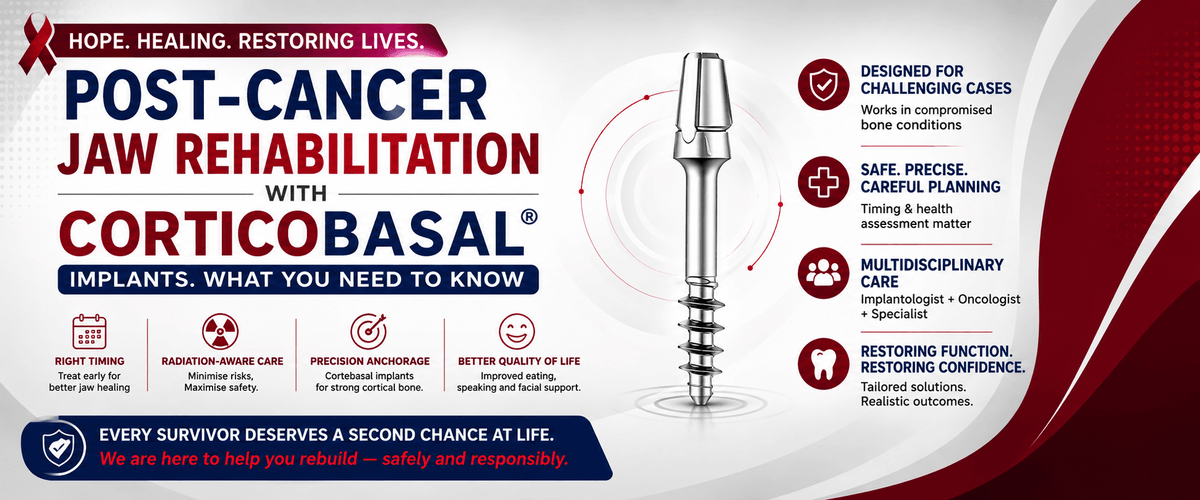
Where regions of cortical bone remain intact and have not been directly irradiated or surgically removed, Corticobasal® implants may offer a different risk profile compared to conventional crestal placement. Because their anchorage is primarily mechanical in dense cortical bone — rather than dependent on the softer bone healing process that radiation compromises — there is clinical rationale for evaluating this approach in selected post-cancer patients.
This is a complex, niche area of implant dentistry. Not every clinic offering Corticobasal® implants has experience managing the intersection of oncological history, altered anatomy, compromised healing, and implant biomechanics. Patients seeking post-cancer rehabilitation require a team with this specific combination of knowledge.
The Multidisciplinary Team Requirement
Post-cancer jaw rehabilitation cannot be managed by the implant surgeon alone. It requires active coordination with the patient’s oncologist, and in many cases a maxillofacial surgeon or oral medicine specialist. The implant plan must account for the altered anatomy, the condition of the remaining bone and soft tissue, and the prosthetic goals.
The goal is to restore as much function and quality of life as the tissues and bone can realistically support — not to replicate the pre-cancer state, but to achieve meaningful, stable rehabilitation within the constraints of the clinical situation.
Frequently Asked Questions
Q: How long after cancer treatment can dental implants be considered?
There is no fixed universal timeline. Most specialists require a minimum of twelve to eighteen months after completing radiation therapy, combined with confirmed oncological clearance. The specific timeline depends on radiation dose, field, the patient’s recovery, and the oncologist’s input.
Q: Can patients who received head and neck radiation get dental implants?
In some cases, yes — subject to careful evaluation, appropriate timing, and assessment of bone quality. Radiation significantly affects implant risk, and outcomes depend on the dose received, areas irradiated, and the implant approach. This must be assessed case by case.
Q: What is osteoradionecrosis, and does it prevent dental implants?
Osteoradionecrosis is a condition where irradiated bone loses its healing capacity. Established osteoradionecrosis is a significant contraindication to elective implant surgery. However, not all patients who receive radiation develop this condition, and where the bone quality is adequately preserved, implant options may still be evaluated.
Q: Who should be involved in my implant assessment after cancer treatment?
Your oncologist, dentist/implantologist, and in many cases a maxillofacial specialist should all be part of the assessment process. No implant plan should proceed without oncological clearance and a full understanding of how cancer treatment has affected your jaw anatomy and healing capacity.
If you are a cancer survivor seeking rehabilitation guidance, arrange a clinical case review with Dr. Vivek Gaur in Kaushambi, Ghaziabad. A multidisciplinary assessment will determine what may be possible for your specific situation.
Disclaimer: This article is for general health awareness only. A formal diagnostic evaluation by a registered dental surgeon and the patient’s oncologist is required before any treatment decision is made. This content is informational and does not constitute medical advice for cancer patients.