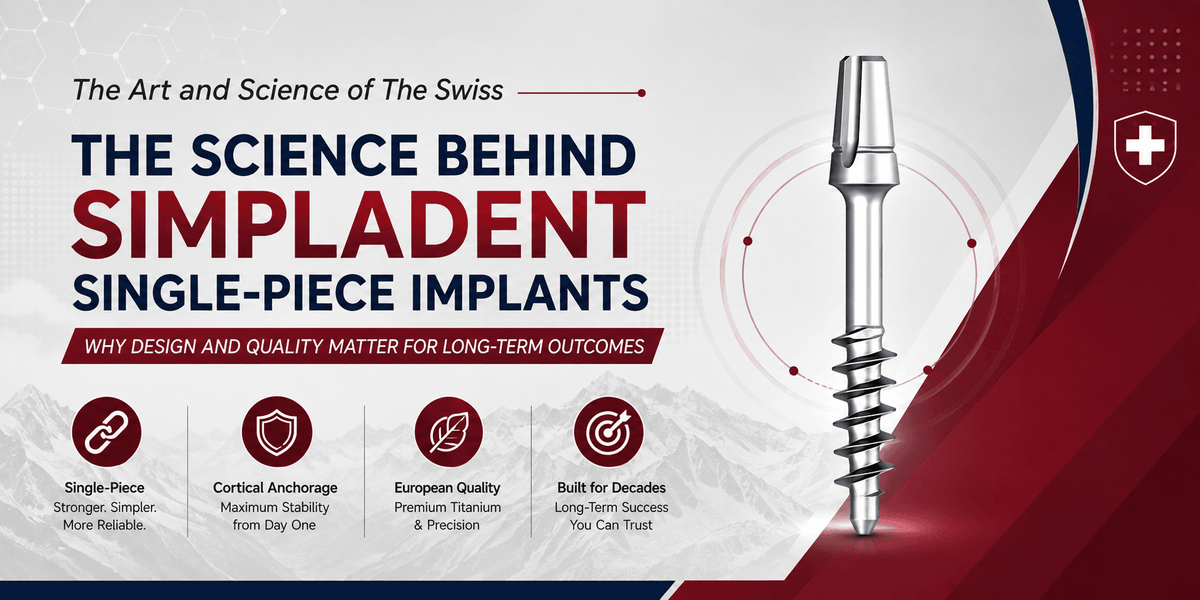
The art and science of The Swiss
When patients compare dental implant options, the conversation usually focuses on the number of implants, the prosthesis type, or the cost. Rarely does it focus on the implant itself — the piece of engineered titanium that will remain in the jaw for decades. Yet the design, material quality, and manufacturing standards of the implant are directly relevant to whether the outcome holds up over ten, fifteen, or twenty years.
The Simpladent implant system, developed with European engineering standards, reflects a specific clinical philosophy about what makes an implant reliable over time. This guide explains the design principles behind single-piece implants and why they matter clinically.
Please contact us @ +91 9289678861 for more info
What a Single-Piece Implant Design Achieves
Most conventional dental implants consist of multiple components — a screw-type fixture buried in the bone, a separate abutment that connects at gum level, and then the crown or bridge on top. Each connection between components is a potential site of mechanical stress, micro-movement under load, and bacterial accumulation over time.
Cortical Anchorage: The Mechanical Principle Behind Stability
Simpladent implants — including the Corticobasal® designs — are engineered to engage the cortical bone layer rather than relying primarily on integration with softer cancellous bone. The thread profile, pitch, and implant diameter are designed to achieve high engagement with the dense cortical plate at the time of insertion.
This cortical engagement produces the primary stability that enables immediate loading in suitable cases: the implant locks into dense bone with sufficient mechanical grip to bear a controlled prosthetic load before biological osseointegration is complete. Softer bone does not produce this level of immediate stability — which is why this design matters specifically for patients with compromised crestal bone.
Material Quality: Why It Is Not a Minor Detail
Simpladent implants are manufactured from medical-grade titanium — the established material standard in implant dentistry. Titanium is biocompatible (it does not provoke immune rejection in most patients), has a long clinical track record, and forms a chemical bond with bone through osseointegration.
The global dental implant market includes products across a wide quality range, with significant variation in material purity, dimensional consistency, and surface preparation. Low-cost implants may fail to meet the biocompatibility and manufacturing precision standards that determine how reliably an implant integrates and functions over years. Patients should ask the clinic specifically which implant brand they use and what quality certification it carries.
Surface Technology and Osseointegration
The surface texture of an implant affects how quickly and securely bone bonds to it. Roughened implant surfaces — achieved through sandblasting, acid etching, or similar processes — provide greater surface area for bone contact and generally support faster osseointegration compared to smooth surfaces.
In the context of cortical anchorage (where primary mechanical stability is high from placement), the surface treatment further supports the biological integration that occurs over the following weeks and months. Both mechanisms — mechanical and biological — contribute to the long-term stability of the implant.
Prosthetic Integration: The System View
The implant is only one element of a system. The prosthetic bridge — its material, design, and occlusal (bite) calibration — must integrate precisely with the implant positions. A well-designed prosthesis distributes chewing forces evenly across all supporting implants, reducing peak stress at any single implant site. Poor prosthetic design concentrates stress and accelerates bone loss around implants over time.
Simpladent’s approach integrates the implant design with the prosthetic protocol, ensuring the surgical and prosthetic components are planned as a coherent system from the outset. At Dr. Vivek Gaur’s clinic in Kaushambi, Ghaziabad, this integrated planning is standard practice for all full mouth and complex cases.
Frequently Asked Questions
Q: What does ‘European quality standards’ mean for dental implants?
European-manufactured implants must meet CE marking requirements and ISO 13485 manufacturing standards for medical devices. These certifications define minimum thresholds for biocompatibility, dimensional precision, and quality management in production. They are a meaningful quality indicator.
Q: Are all single-piece implants the same?
No. Single-piece implant design varies significantly between manufacturers. Thread geometry, material grade, surface treatment, and dimensional tolerances all differ. The clinical performance of a single-piece implant depends on the quality of its engineering and manufacture.
Q: Can Simpladent implants be used for single tooth replacement?
Yes. Simpladent’s product range and clinical application should be discussed during your consultation. The implant system selected for your case depends on the specific clinical situation — the missing tooth position, available bone, and prosthetic requirements.
Q: How do I verify the quality of the implants being placed at a clinic?
Ask specifically: What brand of implant will you use? Where is it manufactured? What certification does it carry? A clinic committed to transparency will answer these questions directly. Refusal or vague responses should prompt further scrutiny.
Discuss your implant options at the Simpladent clinic, Kaushambi, Ghaziabad. Dr. Vivek Gaur provides clear diagnostic dental implant guidance and transparent treatment planning tailored to your bone condition and prosthetic goals.
Disclaimer: This article is for general health awareness only. A formal diagnostic evaluation by a registered dental surgeon is required before any treatment decision is made.