Most patients who search for dental implants online encounter one kind of solution: a titanium screw placed into the upper layer of the jawbone, followed by months of waiting for it to fuse with bone. That protocol works well for a specific type of patient — one with healthy, reasonably intact bone and no complicating health conditions. For patients who have been wearing dentures for years, or who have significant bone loss, or who have been told by more than one dentist that their bone is simply “not enough ” for standard implants — a different clinical approach exists. Corticobasal® implants were designed precisely for cases like these. Understanding how they differ from conventional implants is the first step toward knowing whether they may be a clinical option for you.
The Anatomy Behind the Approach
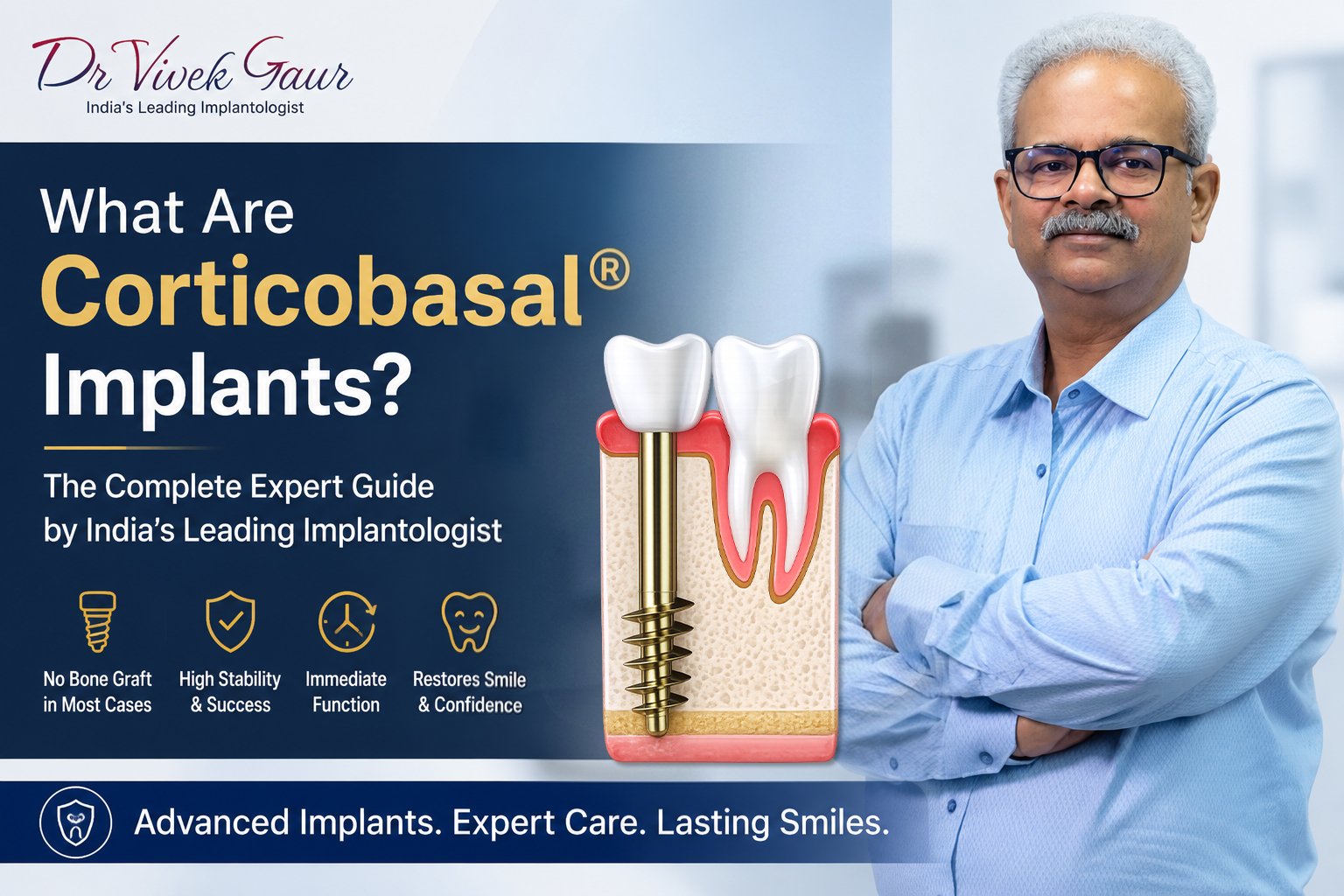
The jawbone is not uniform. The top layer — called crestal or cancellous bone — is relatively soft and biologically active. It responds to chewing pressure by maintaining density. Once teeth are lost, that stimulation stops, and the bone shrinks. This is called resorption, and it happens gradually over years. Beneath this crestal layer lie the cortical and basal bone: dense, compact, and structurally stable. These deeper layers support the jaw itself and are far more resistant to the resorption that consumes the crestal region. Corticobasal® implants are engineered to anchor in these deeper layers rather than relying on the surface bone that has deteriorated.
Please contact us @ +91 9289678861 for more info
Table of Contents
ToggleHow Corticobasal® Implants Work Differently
The jawbone is not uniform. The top layer — called crestal or cancellous bone — is relatively soft and biologically active. It responds to chewing pressure by maintaining density. Once teeth are lost, that stimulation stops, and the bone shrinks. This is called resorption, and it happens gradually over years. Beneath this crestal layer lie the cortical and basal bone: dense, compact, and structurally stable. These deeper layers support the jaw itself and are far more resistant to the resorption that consumes the crestal region. Corticobasal® implants are engineered to anchor in these deeper layers rather than relying on the surface bone that has deteriorated.
How Corticobasal® Implants Work Differently
A conventional implant is placed vertically into the crestal bone, where it sits while the bone grows around it — a process called osseointegration that typically takes three to six months. The implant's long-term stability is largely biological: the stronger the bone growth, the better the outcome. Corticobasal® implants achieve stability differently. The implant's thread and geometry are designed to engage the cortical plate through a lateral or oblique path, locking into dense bone mechanically from the moment it is placed. There is still biological integration over time, but primary stability does not depend on the softer crestal bone healing around the implant. This is why, in suitable cases, a fixed provisional prosthesis can sometimes be attached within days of surgery.
Why Bone Grafting Can Be Avoided in Suitable Cases
Bone grafting is the conventional answer when crestal bone is insufficient. A graft procedure adds bone material to the resorbed site, waits several months for integration, and then allows implant placement. It extends total treatment by six months to over a year, carries real surgical risks — including graft failure and infection — and doesn't guarantee a sufficient result. Because Corticobasal® implants bypass the resorbed crestal layer and anchor in the cortical and basal bone, many patients who would otherwise be directed toward bone grafting can be evaluated for this approach instead. The decision depends on the volume and density of available cortical bone, which is mapped using a 3D CBCT scan before any treatment plan is confirmed. Not every patient will qualify — but the evaluation process can reveal whether a graft-free path exists.
Who May Be Suitable — and Who May Not
Suitability for Corticobasal® implants is determined by clinical evaluation and imaging, not by self-assessment online. That said, this approach has been clinically applied in cases involving patients with moderate to severe crestal bone loss, those with a history of gum disease that caused bone deterioration, individuals with failed conventional implants, and patients whose systemic health makes prolonged grafting protocols inadvisable. Some patients do not present enough cortical bone for this approach either, or have anatomical factors that make placement technically unfeasible. A 3D scan and a face-to-face consultation with a specialist trained in strategic implantology — as Dr. Vivek Gaur is — is the only honest way to determine which clinical path applies to your specific situation.
Training and Expertise: Why It Matters Here
Corticobasal® implantology demands specialised training that standard implant dentistry programs do not include. Implant trajectories are more complex, the anatomy must be mapped in 3D, and the prosthetic design must integrate precisely with each implant position. Poorly placed Corticobasal® implants carry the same surgical risks as any misplaced implant. Dr. Vivek Gaur trained in Corticobasal® and strategic implantology at international centres — including programs in Munich and Switzerland where much of this technique was developed. For patients considering this treatment at the clinic in Kaushambi, Ghaziabad, this specific background is directly relevant to clinical outcome.
Frequently Asked Questions
Corticobasal® implantology demands specialised training that standard implant dentistry programs do not include. Implant trajectories are more complex, the anatomy must be mapped in 3D, and the prosthetic design must integrate precisely with each implant position. Poorly placed Corticobasal® implants carry the same surgical risks as any misplaced implant. Dr. Vivek Gaur trained in Corticobasal® and strategic implantology at international centres — including programs in Munich and Switzerland where much of this technique was developed. For patients considering this treatment at the clinic in Kaushambi, Ghaziabad, this specific background is directly relevant to clinical outcome.
Q: What makes Corticobasal® implants different from regular dental implants?
Standard implants anchor in the soft crestal (surface) bone and rely on bone growing around them over several months. Corticobasal® implants engage the denser cortical and basal bone layers and achieve mechanical stability at the time of placement. This is the basis for their suitability in patients with reduced crestal bone.
Q: Can Corticobasal® implants always be placed without bone grafting?
Not always. In many suitable cases, yes — because they anchor in bone that hasn’t resorbed. But suitability depends on the density and volume of available cortical bone, confirmed by 3D imaging. Some patients may still require grafting or a different approach altogether.
Q: Is everyone a candidate for Corticobasal® implants?
No. Suitability depends on the patient's bone structure, overall health, and oral condition. A clinical evaluation and CBCT scan are required before any treatment plan is discussed. Dr. Vivek Gaur assesses each case individually at the Simpladent clinic in Kaushambi, Ghaziabad.
Q: How long does Corticobasal® implant treatment take?
Timelines vary by case. In suitable cases where immediate loading is possible, provisional fixed teeth may be placed within days of surgery. The final prosthesis is typically fitted after a stabilisation period of a few months. Your treating surgeon will confirm the likely timeline after evaluation.
Q: Are Corticobasal® implants safe?
When planned using 3D imaging and placed by a trained specialist, Corticobasal® implants have a well-documented clinical record. As with any surgical procedure, there are risks that your surgeon will explain during the consultation. No outcome can be guaranteed; success depends on individual health, bone quality, surgical precision, and post-treatment maintenance.
Consult Dr. Vivek Gaur at the Simpladent clinic, Kaushambi, Ghaziabad, to find out whether Corticobasal® implants may be clinically suitable for your case. Treatment planning depends on oral health, bone condition, and medical history.
Disclaimer: This article is for general health awareness only. A formal diagnostic evaluation by a registered dental surgeon is required before any treatment decision is made.