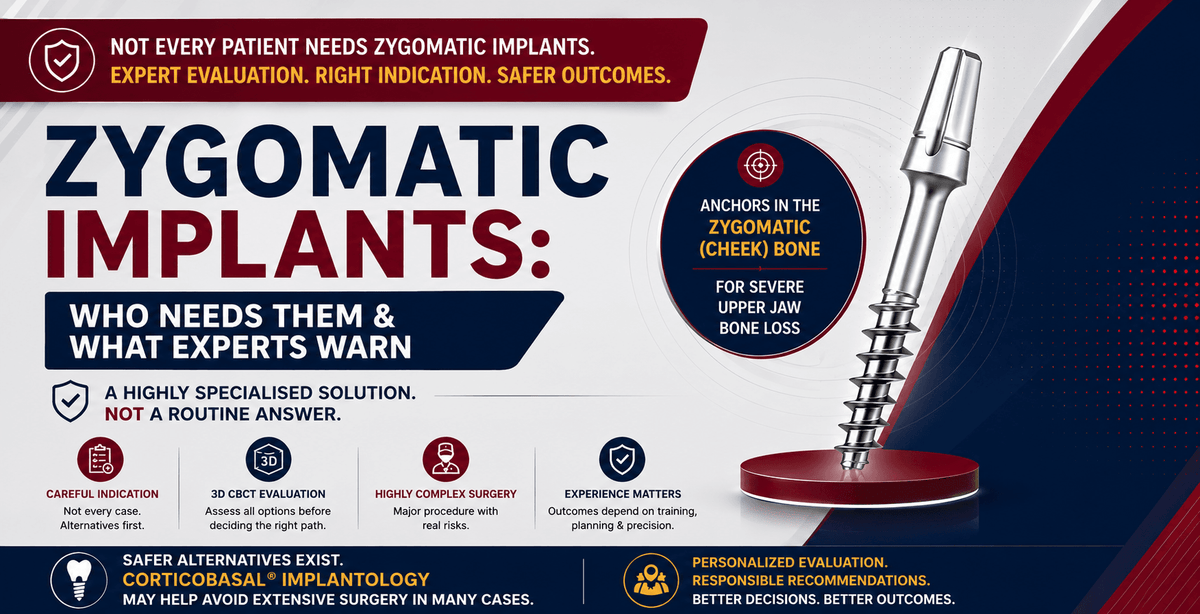
Zygomatic implants are one of the most technically demanding procedures in implant dentistry. They anchor not in the jawbone but in the zygomatic (cheek) bone — a structure that remains intact even when the upper jaw has deteriorated severely. For a specific, clearly defined group of patients, this can be a viable pathway to fixed teeth. For a much larger group, it is unnecessary and avoidable completely !
Understanding the genuine indication for zygomatic implants — and the difference between that and overuse of a high-risk procedure — is something patients deserve to know before they consent to surgery.
What Zygomatic Implants Are.
Please contact us @ +91 9289678861 for more info
Zygomatic implants are significantly longer than standard implants, typically 30 to 50 mm. They bypass the upper jawbone entirely and anchor into the cheekbone. Over time, the indication expanded to patients with severe upper jaw resorption. Whether this expansion has always been clinically appropriate is a question worth asking. Not every patient with upper jaw bone loss is a true zygomatic implant candidate.
The Real Risk Profile Patients Should Know About
This is major surgery. Zygomatic implant placement is typically performed under general anaesthesia in countries like USA. In India, it is largely done under local anaesthesia. The implant path passes through or near the maxillary sinus. Documented complications include sinus infection (sinusitis), sinus membrane perforation, soft tissue infection at the cheek entry point, and in rare but serious cases, damage to adjacent anatomical structures. These risks do not mean the procedure is unsafe in all hands — in experienced hands with precise 3D surgical planning, outcomes can be good for correctly selected patients. The critical word is “experienced.” In India, very few implant surgeons have the case volume and training to perform zygomatic implant surgery reliably. The gap between a trained zygomatic surgeon and a practitioner attempting the procedure without that background is clinically significant.
When Zygomatic Implants Are Not the First Answer
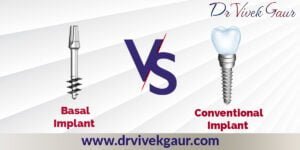
Many patients referred for zygomatic implants have not been thoroughly evaluated for alternatives. Advanced implant techniques — including Corticobasal® implantology and basal implant placement — can address significant upper jaw bone loss without requiring anchorage in the cheekbone. Before agreeing to zygomatic surgery, it is clinically appropriate to ask whether less invasive approaches have been formally evaluated and ruled out.
At Dr. Vivek Gaur’s clinic in Kaushambi, Ghaziabad, Zygomatic implants are kept like the absolute last option. Why go for extensive procedures when the entire treatment can be easily done without any cuts and sutures ?
Questions Every Patient Should Ask Before Agreeing
If a surgeon recommends zygomatic implants for your case, you are entitled to ask:
• Has a CBCT scan been used to specifically evaluate whether Corticobasal® or basal implant alternatives are feasible?
• How many zygomatic implant cases has this surgeon personally completed?
• What is the plan if sinus complications develop post-operatively?
Why Specialist Evaluation Matters More Here Than Anywhere
Zygomatic implantology sits at the intersection of advanced implant surgery and oral and maxillofacial surgery. The training required for safe, reliable outcomes goes beyond the standard implant dentistry curriculum. For patients in India exploring this option, seeking out a specialist with documented international training and specific case experience in zygomatic placement is not optional — it is what responsible care looks like.
Frequently Asked Questions
Q: Are zygomatic implants the only option for patients with severe upper jaw bone loss?
Not necessarily. Advanced techniques such as Corticobasal® implantology may allow treatment in cases with significant bone loss without requiring zygomatic anchorage in suitable patients. A 3D evaluation is needed to determine which approach applies.
Q: How long does recovery take after zygomatic implant surgery?
Recovery varies by case. Zygomatic surgery is a major procedure performed under anaesthesia. Post-operative swelling, restricted diet, and follow-up care are required. Your surgeon will provide a full recovery protocol based on your specific case.
Q: Is zygomatic implant surgery done under local or general anaesthesia?
Zygomatic implant surgery is typically performed under general anaesthesia or deep sedation, given the surgical complexity. This requires a facility with appropriate anaesthetic support and monitoring capability.
Q: Can zygomatic implants fail?
Yes. Failure rates are higher than for conventional crestal implants and are significantly affected by surgeon experience, 3D planning accuracy, and patient factors including sinus health and bone quality. This is why case selection and surgical expertise are paramount.
If you have been told zygomatic implants are your only option, arrange a clinical case review with Dr. Vivek Gaur in Kaushambi, Ghaziabad. A full evaluation will determine whether safer alternatives apply to your case.
Choose the easiest form of dental implant treatment ! Choose Corticobasal®
implantology
Disclaimer: This article is for general health awareness only. A formal diagnostic evaluation by a registered dental surgeon is required before any treatment decision is made.