Patients researching dental implants in India often come across two very different approaches — conventional crestal implants on one side and Corticobasal® or basal implants on the other. Marketing from both sides can make the comparison confusing. This article cuts through that and offers a clinically grounded side-by-side look at what actually differs, and why those differences matter for specific types of patients.
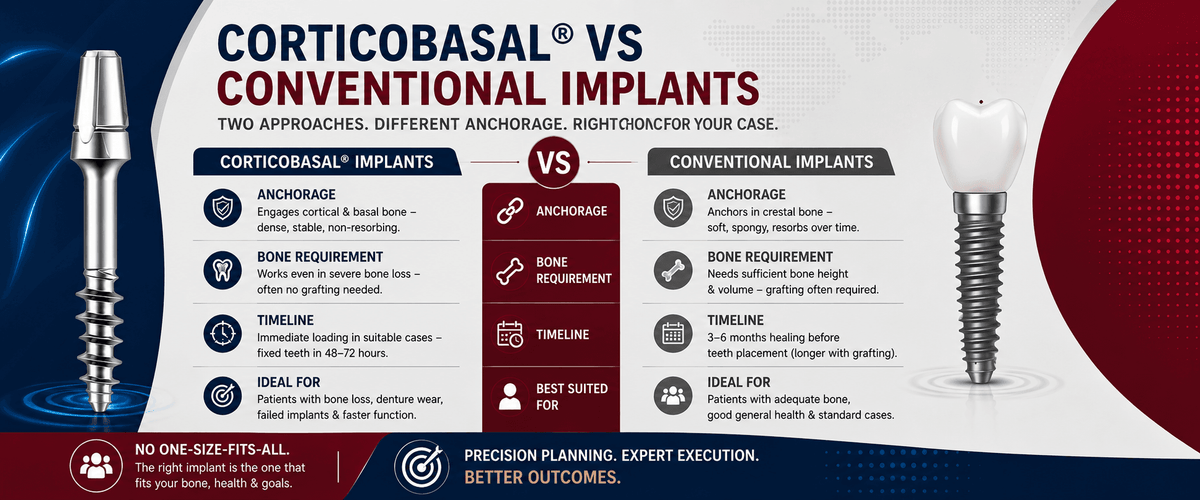
Anchorage: Where Each Implant Sits
Conventional implants anchor in the crestal bone — the soft, spongy upper layer of the jaw. This bone undergoes osseointegration with the implant surface over three to six months, forming the biological bond that gives the implant its long-term stability.
Please contact us @ +91 9289678861 for more info
Corticobasal® implants anchor in the cortical and basal bone — the dense, compact deeper layers that are far more resistant to resorption. Stability here is primarily mechanical, achieved at placement through the implant’s engagement with the hard cortical plate. Biological integration still occurs, but the implant does not depend on the softer crestal bone healing around it.
Bone Requirements: The Critical Difference for Many Patients
Conventional implants require a minimum volume and height of crestal bone at each implant site. When that bone is insufficient — due to years of tooth loss, gum disease, or long-term denture wear — bone grafting is typically recommended to rebuild the foundation.
Corticobasal® implants bypass this requirement in suitable cases by engaging deeper bone that has not resorbed. This is the primary clinical advantage for patients with significant bone loss. Not every such patient will qualify — the anatomy must be assessed via CBCT — but the possibility of implant placement without grafting is the defining distinction for this patient group. Every case is a Corticobasal® implant case if done by the right expert like Dr Vivek Gaur in Delhi.
Treatment Timeline
Conventional implants follow a staged protocol: implant placement, three to six months of healing, then prosthetic placement. Total treatment from extraction to final crown can span six to eighteen months or more, especially if bone grafting is involved.
In suitable Corticobasal® cases, immediate loading can be applied — a fixed provisional bridge attached within 48 to 72 hours of surgery. The final prosthesis follows months later, but patients are not left without teeth during the healing period. For many patients, particularly those who have struggled with dentures for years, this timeline difference is significant.
Surgical Complexity
Standard crestal implant surgery for single or a few teeth is within the scope of many trained dentists. Corticobasal® implantology requires specialised training. Implant trajectories differ significantly from conventional placement, requiring precise 3D planning and surgical execution. Full mouth Corticobasal® cases are complex, multi-implant surgeries that must be managed by a specialist with specific experience in this technique.
This training difference is relevant when patients compare clinics. A dentist who places conventional implants does not automatically have the competence to perform Corticobasal® treatment correctly.
How to choose the right Corticobasal® implant doctor for your treatment? WATCH THIS VIDEO NOW !
Evidence Base
Conventional crestal implants have one of the most thoroughly documented clinical records in all of dentistry — decades of long-term follow-up, meta-analyses, and published success data. Corticobasal® and basal implants have a growing published evidence base, with documented outcomes in patients with reduced bone who were not candidates for conventional placement. The evidence base is developing, but meaningful literature exists for appropriately selected cases.
Which Is Right for Your Case?
The answer is not about preference — it is about clinical suitability. Patients with adequate bone, good general health, and no complicating factors may be well served by conventional implants. Patients with bone loss, previous implant failure, systemic conditions affecting healing, or need for faster functional recovery may benefit from evaluation for Corticobasal® treatment.
In many full mouth cases, a combination of implant designs may be used based on the anatomy. There is no single superior system — only the system that best matches the individual patient’s bone, health, and prosthetic goal.
Frequently Asked Questions
Q: Are Corticobasal® implants more expensive than conventional implants?
Cost depends on the number of implants, the prosthesis type, and the complexity of the case. Avoid comparing flat prices between systems without understanding what is included. A detailed treatment plan from a specialist is the only basis for accurate cost comparison.
Q: If conventional implants fail, can Corticobasal® implants be used as a replacement?
In many cases, yes. Patients with previous implant failure are evaluated for Corticobasal® or basal implant options, which use different bone locations and anchorage mechanisms. A full diagnostic evaluation is required to assess feasibility.
Q: Do Corticobasal® implants last as long as conventional implants?
Implant longevity depends on bone quality, oral hygiene, systemic health, and maintenance — for both types. Neither system offers a guaranteed lifespan. Long-term outcomes for Corticobasal® implants in selected patients are reported positively in the clinical literature, but individual results always vary.
Q: How do I know which type is right for my case?
Only a clinical evaluation with 3D imaging can answer this. Consult a specialist who has training in both conventional and Corticobasal® techniques, so the recommendation reflects what is genuinely best for your anatomy rather than what the clinic typically offers.
Book a clinical evaluation with Dr. Vivek Gaur at Simpladent, Kaushambi, Ghaziabad to receive a personalised treatment plan that identifies which implant approach best suits your bone structure, health, and goals.
Disclaimer: This article is for general health awareness only. A formal diagnostic evaluation by a registered dental surgeon is required before any treatment decision is made.