About Dr. Vivek Gaur | Dental Implant Specialist, Kaushambi, Ghaziabad
In surgical specialties, the correlation between case volume, case complexity, and clinical outcome is well established. Surgeons who have managed a large number of varied and difficult cases develop a level of judgment, pattern recognition, and technical calibration that formal training alone does not produce. In implant dentistry — where individual anatomy, bone quality, and systemic health vary enormously between patients — this accumulated clinical experience directly shapes outcomes.
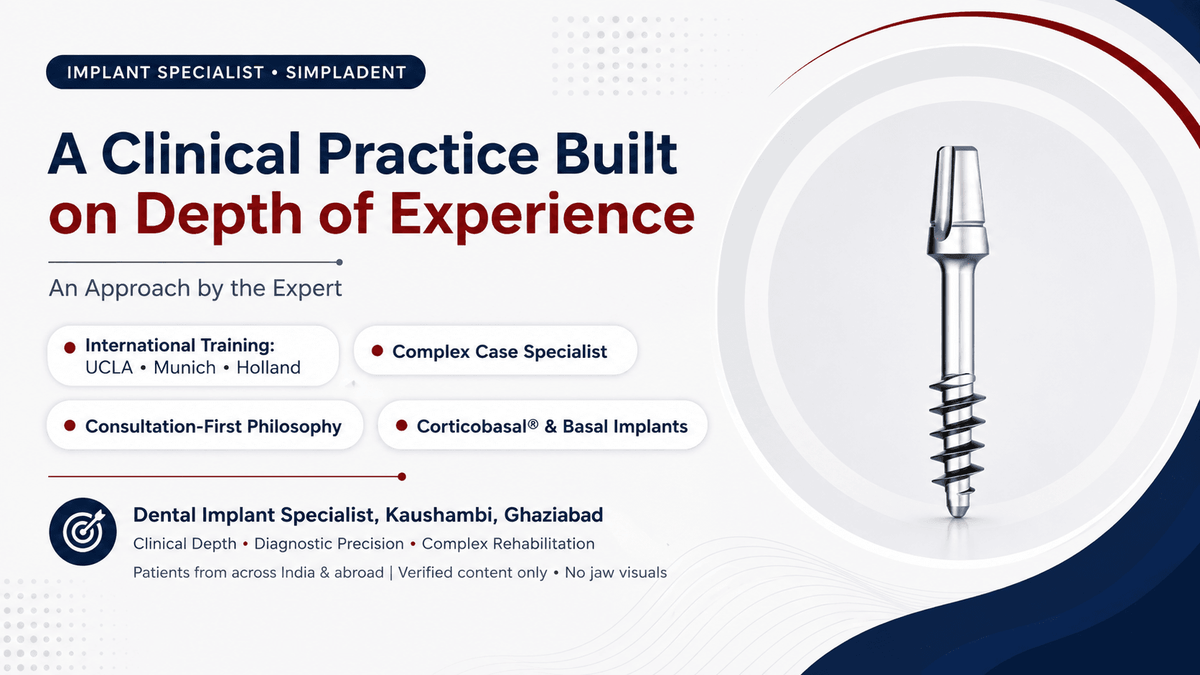
Dr. Vivek Gaur’s approach to implantology was built through deliberate pursuit of this depth: international training in the specific techniques he practises, and a focused clinical practice centred on the cases that other clinics find difficult to manage. This article describes that approach and what it means for patients who come to the Simpladent clinic in Kaushambi, Ghaziabad.
Please contact us @ +91 9289678861 for more info
The Foundation: International Specialist Training
The most advanced implant techniques — Corticobasal® implantology, strategic basal implant placement, full mouth immediate loading in compromised bone — were developed and refined in specific European training centres. Dr. Gaur’s training included programmes at internationally recognised institutions in the United States (UCLA), Germany (Munich), and the Netherlands (Holland).
This cross-continental training provided something that a single-curriculum education cannot: exposure to different schools of thought in surgical planning, prosthetic design, and complex case management. The ability to synthesise these perspectives is what distinguishes a clinician who has genuinely extended their practice from one who has simply accumulated years.
A Consultation-First Clinical Philosophy
The clinic’s approach is built around personalised diagnostic evaluation before any treatment plan is discussed. Every patient — whether presenting with straightforward tooth loss or with a history of multiple failed implants and severe bone loss — begins with a thorough clinical examination, detailed medical and dental history review, and 3D imaging where indicated.
This consultation-first approach reflects a clinical philosophy that prioritises matching the treatment to the patient’s actual anatomy and health, rather than applying a standard protocol and adapting the patient to it. For complex cases, this distinction is the difference between a plan that genuinely fits and one that looks right on paper but creates problems intraoperatively.
The Case Profile: Who Comes to This Practice
A significant portion of the clinical case load involves patients who have been declined treatment or referred for major bone augmentation elsewhere. Patients with severe jaw bone loss, those with systemic conditions complicating standard approaches, those who have had conventional implants fail, and those who have worn dentures for many years and been told implants are not an option.
Managing these cases requires more than technical skill. It requires the diagnostic confidence to look at a complex CBCT and identify viable cortical bone where a less experienced eye sees only the problem, and the surgical judgment to design a plan that works within the constraints the patient’s anatomy presents.
Education and Knowledge Transfer
Practitioners who commit to a specialised field at depth tend to contribute to the education of other clinicians — because systematic teaching requires an even more rigorous understanding of what you do and why you do it. Dr. Gaur’s engagement with training and lectures in implantology reflects this dimension of clinical practice.
For patients, this has a practical implication: a clinician who teaches must be able to articulate clinical reasoning clearly, not just execute a procedure. That clarity extends to patient communication — explaining what is planned, why, and what the realistic outcome is, in terms a patient without a dental background can understand.
Making International-Standard Care Available in India
One consistent motivation behind Dr. Gaur’s practice is making the level of specialised implant care available internationally accessible to patients in India — particularly those who have complex needs but cannot travel abroad. Delhi NCR is a gateway city, and patients travel to the Kaushambi clinic from across India and from abroad for this reason.
Frequently Asked Questions
Q: What types of cases does Dr. Vivek Gaur’s clinic specialise in?
The clinic has a specific focus on complex implant cases: patients with significant bone loss, those who have had conventional implants fail, full mouth rehabilitation using Corticobasal® and basal implant techniques, and patients with systemic health conditions that complicate standard protocols.
Q: Does Dr. Gaur treat patients from outside Delhi NCR?
Yes. Patients travel to the Simpladent clinic in Kaushambi, Ghaziabad from across India. International patients are also received. A remote preliminary consultation is available for patients planning to travel.
Q: How should I prepare for my first consultation?
Bring all existing dental records — X-rays, CBCT scans if available, photographs of your teeth, and documentation of any previous implant treatment. Also bring a list of current medications and details of any systemic health conditions. This information allows the team to prepare for your case before the appointment.
Arrange a clinical case review with Dr. Vivek Gaur at the Simpladent clinic, Kaushambi, Ghaziabad. Comprehensive implant planning for complex bone configurations — personalised diagnostic evaluation is the starting point.
Disclaimer: This article is for general health awareness only. A formal diagnostic evaluation by a registered dental surgeon is required before any treatment decision is made.