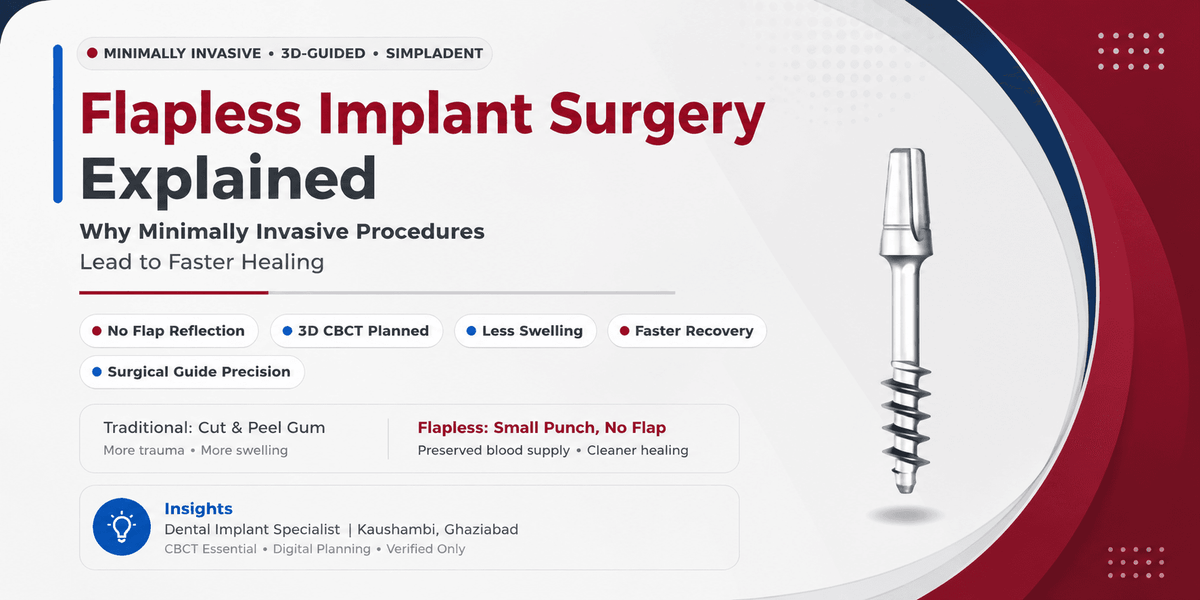
Traditional implant surgery involves cutting and peeling back the gum tissue to expose the jawbone — a technique called reflecting a flap. The surgeon works with direct visibility of the bone, places the implant, and sutures the tissue back afterward. It is reliable, and for many cases it remains the appropriate approach.
Flapless implant surgery works differently. Instead of reflecting the gum tissue, the surgeon places the implant through a small tissue punch or a minimal incision, without lifting a flap. The result, in suitable cases, is reduced tissue trauma, less post-operative swelling, and a more comfortable recovery. What makes this possible is the digital planning that replaces direct visual access to the bone.
The Technology That Makes Flapless Surgery Safe
Traditional open flap surgery allows the surgeon to see and verify exactly what they are working with. Flapless surgery replaces that visual access with data — specifically, the 3D data produced by a CBCT scan. This scan shows the bone volume, density, nerve positions, and sinus location in precise three-dimensional detail, giving the surgeon a complete picture of the surgical site without needing to open it.
Clinical Advantages of the Flapless Approach
Preserving the gum tissue architecture is the most significant biological benefit. Reflecting a flap disrupts the vascular supply to the tissue and the bone margin, affecting the healing environment. Flapless technique avoids this disruption — blood supply to the tissue is maintained, healing is cleaner, and the biological environment at the implant site is better preserved.
Patients who undergo flapless implant placement consistently report less post-operative swelling, less discomfort, and a more comfortable first week compared to open flap cases of similar complexity. Procedure time is also typically shorter. For patients who experience anxiety about dental surgery, a procedure that is shorter, involves less bleeding, and produces a more comfortable recovery is genuinely significant.
3D Planning as the Standard of Care
Whether a case is performed flapless or with a flap, modern implant practice in centres like Simpladent relies on 3D digital planning as a foundation. The quality of the scan, the precision of the digital implant positioning, and the accuracy of the surgical guide determine the outcome. Patients evaluating implant clinics in Delhi NCR should ask specifically whether 3D-guided planning is used as standard — it is an indicator of the diagnostic rigour behind the treatment.
Frequently Asked Questions
Q: Does flapless surgery mean there is no incision at all?
Flapless surgery typically involves a small tissue punch or minimal incision to access the bone — it does not reflect or lift the gum tissue as traditional flap surgery does. The degree of tissue access required depends on the specific case and anatomical position of each implant.
Q: Is flapless surgery suitable for full mouth implant cases?
In suitable full mouth cases with adequate bone and precise 3D planning, flapless or minimally invasive approaches can be applied. The feasibility is determined by the CBCT scan and surgical planning process for each individual case.
Q: How much faster is recovery after flapless surgery?
Recovery timelines vary by patient and case complexity. Flapless surgery generally results in less swelling and faster soft tissue healing compared to traditional flap cases of similar size. However, the implant integration process — which occurs in the bone — proceeds on the same biological timeline regardless of the surgical approach used.
Q: Is a CBCT scan always needed for flapless surgery?
Yes. A CBCT scan is essential for safe flapless implant placement. Without a 3D bone map, the surgeon cannot safely navigate the anatomy without direct visual access. Clinics offering flapless surgery without CBCT scanning are not following an appropriate standard of care.
Plan your consultation with Dr. Vivek Gaur at Simpladent, Kaushambi, Ghaziabad to find out whether flapless implant placement may be suitable for your case, based on 3D imaging and a personalised treatment plan.
Disclaimer: This article is for general health awareness only. A formal diagnostic evaluation by a registered dental surgeon is required before any treatment decision is made.