Diabetes and oral health are linked in ways that run deeper than most patients realise. Poor blood sugar control worsens gum disease. Chronic gum disease makes blood sugar harder to control. And for patients who have lost teeth — which is more common in diabetics than the general population — the decision to pursue dental implants raises legitimate questions about safety, healing, and success.
The short answer is that diabetes does not automatically disqualify anyone from dental implants. The longer, more important answer is that it changes what the assessment must cover, how the surgical plan must be adapted, and what maintenance looks like afterward. Treatment planning depends on oral health, bone condition, and medical history — and in diabetic patients, that medical history is central, not secondary.
How Diabetes Affects Implant Healing
Elevated blood glucose impairs two things that implant surgery depends on: wound healing and immune response. Cells involved in tissue repair and infection defence are less efficient in a high-glucose environment. For conventional implants, where success depends heavily on the biological process of osseointegration — bone growing around the implant surface — this matters. Slower or incomplete healing can lead to failed integration.
Clinical studies indicate that patients with well-controlled diabetes (HbA1c generally below 7–8%) have implant outcomes broadly comparable to non-diabetic patients when surgery is performed with appropriate protocols. Poorly controlled diabetes significantly increases the risk of early infection, peri-implantitis, and implant loss over time. These findings are general patterns, not guarantees of outcome either way — every case has variables that a proper assessment addresses.
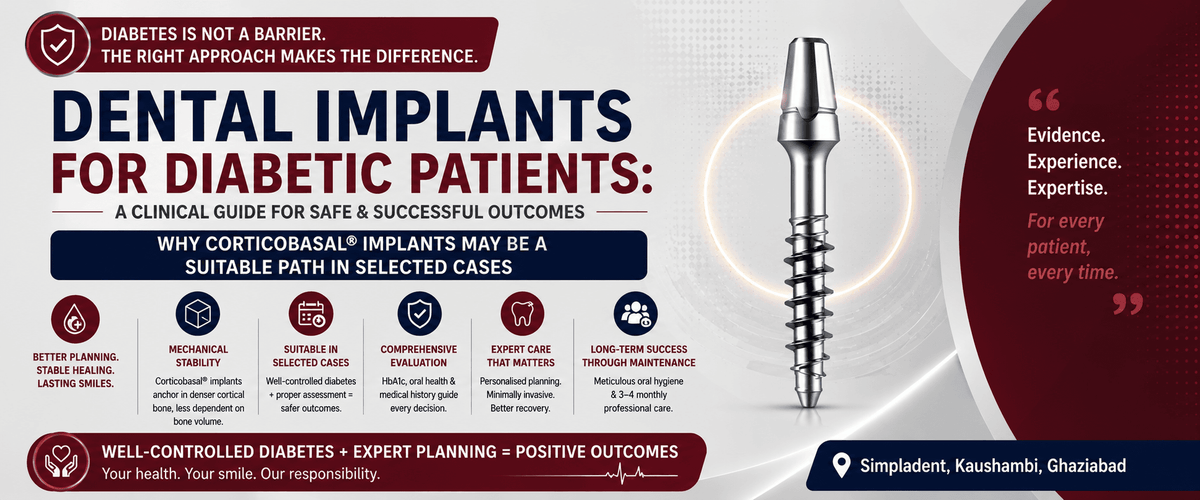
Why Corticobasal® Implants May Be Suitable in Selected Diabetic Cases
The biological process of osseointegration — which crestal implants depend on — is the part most affected by compromised healing in diabetic patients. Corticobasal® implants anchor primarily through mechanical engagement of the dense cortical bone. Their primary stability is not dependent on the soft crestal bone healing process in the same way, which may reduce some of the healing-dependent risk.
This does not make Corticobasal® implants risk-free for diabetic patients, or universally appropriate. But in suitable cases, where blood sugar is well managed and the patient’s anatomy supports cortical anchorage, this approach may present a more viable clinical path than conventional crestal implants for patients whose healing capacity is reduced. Dr. Vivek Gaur’s clinic in Kaushambi, Ghaziabad evaluates each case individually.
What the Pre-Surgical Assessment Covers
Before any implant planning proceeds for a diabetic patient, the clinical team will need to confirm or coordinate the following:
- Current HbA1c level and general diabetes management — ideally in liaison with the patient’s physician
- Status of any existing gum disease — active gum disease must be treated before implant placement
- Current medications and their interaction with anaesthesia and wound healing
- A 3D CBCT scan to assess bone density and volume, which may be affected in long-term diabetics
- Oral hygiene standards — patients must demonstrate they can maintain the environment around implants before surgery is planned
Long-Term Maintenance: Non-Negotiable for Diabetic Implant Patients
Diabetic patients are at higher lifetime risk of peri-implantitis — the infection around implants that mirrors gum disease around natural teeth. Once established, peri-implantitis causes progressive bone loss and can lead to implant failure if not caught and managed early.
For this patient group, professional maintenance appointments every three to four months in the first few years, combined with meticulous daily cleaning, are not recommendations — they are clinical requirements. Implant longevity in diabetic patients is directly correlated with how seriously post-treatment maintenance is taken.
Frequently Asked Questions
Q: Can I get dental implants if my diabetes is not well controlled?
It is not advisable to proceed with implant surgery while diabetes is poorly controlled. The treating team will typically recommend bringing HbA1c within a target range before planning surgery. This is for your safety — impaired healing significantly increases the risk of complications.
Q: Why is gum disease such a concern for diabetic implant patients?
The bacteria responsible for gum disease can also cause peri-implantitis — infection around implants. Diabetic patients are more susceptible to both conditions. Any existing gum disease must be treated and clinically stable before implants are placed.
Q: Are Corticobasal® implants always the right choice for diabetic patients?
Not necessarily. Suitability depends on each patient’s specific health profile, bone quality, and blood sugar management. Some well-controlled diabetic patients may be good candidates for conventional implants. Others may benefit from the cortical anchorage approach. The evaluation determines which applies.
Q: How often do I need professional dental visits after implant treatment if I am diabetic?
More frequently than non-diabetic patients. Typically every three to four months for professional cleaning and implant health assessment in the initial years, with the frequency reviewed over time based on how stable the condition remains.
Discuss your implant options with Dr. Vivek Gaur at the Simpladent clinic, Kaushambi, Ghaziabad. A personalised evaluation covering your health history, blood sugar management, and bone condition is the right starting point.
Disclaimer: This article is for general health awareness only. A formal diagnostic evaluation by a registered dental surgeon is required before any treatment decision is made. Diabetic patients should also consult their treating physician before any surgical procedure.