Dental implants are among the most reliable restorative treatments in modern dentistry. But implant failure does happen — and when it does, particularly after a patient has invested time, money, and hope in a procedure, it is a serious clinical and personal setback. Understanding why implants fail, what signals to watch for, and how specific technologies and protocols reduce the risk is something every implant patient deserves to know.
Failure is not random. It has identifiable causes, and addressing those causes systematically — through choice of implant system, surgical approach, and long-term maintenance — is the most effective protection available.
Early Implant Failure: The Critical First Months
Early failure occurs before or during the osseointegration process, typically within the first few months after placement. The defining sign is implant mobility — the implant moves when pressure is applied, indicating it has not bonded to the bone adequately.
The most common causes of early failure are insufficient bone density at the implant site (preventing stable primary stability), surgical contamination or infection during placement, overloading the implant before integration is complete, and systemic factors — uncontrolled diabetes, smoking, immune-suppressing medications — that impair the healing environment. Each of these is identifiable and, to varying degrees, preventable through proper pre-surgical assessment.
Late Implant Failure: When Problems Emerge After Integration
Late failures occur after the implant has initially integrated, often years after placement. Peri-implantitis is the leading cause — a bacterial infection of the tissue around the implant that causes progressive bone loss and, if untreated, eventually leads to implant loss. It develops and advances silently in many patients, which is why regular professional monitoring is essential.
Mechanical overload is the other major driver of late failure. When bite forces exceed what the surrounding bone can sustain — through poor prosthetic design, an imbalanced bite, or parafunctional habits such as bruxism (grinding) — the bone around the implant recedes. Poorly fitting crowns, lack of bite calibration, and implant positions that concentrate rather than distribute stress all contribute.
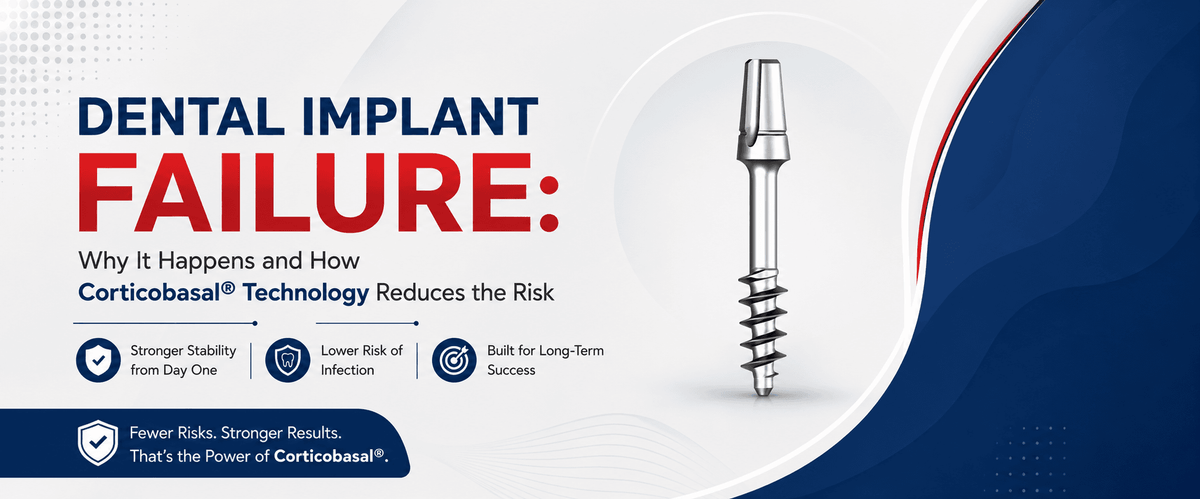
How Corticobasal® Design Addresses Specific Failure Risks
The cortical anchorage principle directly reduces certain early failure risks. By achieving mechanical stability in the dense cortical bone rather than depending on softer crestal bone integration, Corticobasal® implants begin with a more robust primary stability. This reduces the biological dependency that makes crestal implants vulnerable to early failure in compromised bone.
The single-piece design eliminates the abutment-implant junction microgap present in multi-component conventional implants. This microgap is a known site of bacterial accumulation and a recognised pathway for peri-implantitis-related infection. Fewer components mean fewer interfaces for bacteria to colonise and fewer mechanical joints to fail under cyclic loading.
Seven Factors That Increase Implant Failure Risk
Awareness of the specific risk factors allows patients and their treating team to address them before they become problems:
- Uncontrolled diabetes — impairs healing and immune response
- Smoking — reduces blood supply to healing tissue and bone, significantly increasing failure risk
- Unresolved gum disease before implant placement
- Poor oral hygiene maintenance after treatment
- Overloading with immediate loading when primary stability was insufficient
- Poorly designed or imbalanced prosthesis concentrating bite forces
- Absence of regular professional maintenance appointments post-treatment
What Patients Can Do to Protect Their Implants
Technology and surgical precision set the foundation, but long-term implant success is genuinely a shared responsibility. Patients who commit to meticulous oral hygiene, attend scheduled maintenance appointments, manage systemic conditions well, and communicate any pain or unusual sensations around implants promptly are the patients with the best long-term outcomes.
Peri-implantitis caught early is treatable. Caught late, it is often irreversible. This is why treating implants as a passive, permanent solution rather than an investment requiring active maintenance is one of the more common — and preventable — paths to implant failure.
Frequently Asked Questions
Q: How common is dental implant failure?
Failure rates vary significantly by patient health, implant system, surgeon expertise, and maintenance compliance. General dental literature reports early failure rates typically in a single-digit percentage range for well-planned cases, with late failure rates influenced heavily by patient behaviour and maintenance. Your surgeon can discuss the specific risk profile for your case.
Q: Can a failed implant be replaced?
In many cases, yes — after the failed implant is removed, the site is allowed to heal, and the cause of failure is identified and addressed. Some patients benefit from a different implant approach for the replacement, such as switching to a Corticobasal® or basal implant in cases where crestal bone was the original limiting factor.
Q: What are the early warning signs of implant problems?
Pain or tenderness around the implant site, swelling or redness of the gum tissue, visible recession around the implant, movement or looseness, or a foul taste or odour at the site are all signs that should prompt an urgent appointment with the treating team.
Q: Does smoking always lead to implant failure?
Not always, but smoking significantly increases the risk of early failure and peri-implantitis. Most responsible implant teams will discuss this clearly before treatment. Patients who smoke are generally advised to quit or substantially reduce smoking before and after implant placement.
If you have experienced a dental implant failure or want to understand the risks before starting treatment, consult Dr. Vivek Gaur at Simpladent, Kaushambi, Ghaziabad. A clinical evaluation will identify what happened and what options exist.
Disclaimer: This article is for general health awareness only. A formal diagnostic evaluation by a registered dental surgeon is required before any treatment decision is made.